







The first floor houses a gallery featuring rotating exhibitions. The special exhibition “Monet’s Ecology,” dedicated to Claude Monet and held between mid-May and early September last year, drew more than half a million visitors, making it the most attended exhibition in the museum’s history.
The exhibit featured 32 of Monet’s works from between 1870 and the 1920s. Some were being shown in the Southern Hemisphere for the first time, drawing considerable attention. On certain days, visitors were allowed in until 10 p.m., and the dates were even extended so that more people could see it. I went there and was deeply moved by being able to see such magnificent works of art up close. Admission to MASP is free on Tuesdays.

The second floor houses the museum’s permanent collection. The works are displayed on stands or in glass cases, giving the impression that they are floating in space. The use of glass allows you to see the backs of the frames as well, which is interesting. There are masterpieces from famous artists like Van Gogh, Picasso, and Cézanne, as well as Italian Renaissance painters and Brazilian artists.


There are also exhibits on the two underground floors, as well as an auditorium. The museum holds a candlelight concert at the end of the year, which I was able to attend for the first time last year. Three musicians performed Christmas classics by candlelight (not real candles, of course), creating a lovely, peaceful experience that I was grateful to be a part of.

The spacious ground level is called Vão Livre, which means “free space.” This area is constantly hosting free events Friday through Sunday, including shows, yoga, DJ performances, and activities for kids.

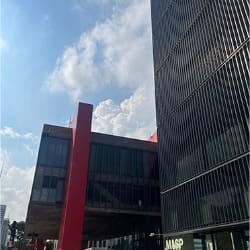
Over the last several years, there was an expansion project to renovate and connect the building next to the museum to create the new Pietro Maria Bardi Building, which opened at the end of March 2025. The new building has 14 floors, with exhibition spaces located on floors two through six. The ground level has a café as well as a restaurant offering chic reinterpretations of Brazilian cuisine.
The underground floor of the new wing has a shop featuring MASP goods and a wide selection of Brazilian handicrafts. It’s a wide-open space where you can spend a lot of time wandering around.

MASP is more than a place to showcase art and culture—it is a modern building that could easily be considered the most iconic structure on Paulista Avenue.
When I was a student, MASP was a landmark where I used to meet up with friends. These days, I’m happy that I can go there to see exhibitions—and even when I’m not going to see the art with friends, I still enjoy spending time at the café.
Incidentally, many of the strikes held in São Paulo also take place in front of MASP.
It is truly a symbol of the city. If you ever get a chance to visit, make sure you stop by and see it!