







Carnevale is a celebration that comes before Easter, and falls on a different day each year. The main event during Carnevale is Martedì Grasso (Mardi Gras), but different cities and towns celebrate it during different periods that peak at different times. The Carnevale di Venezia is known as one of the most elaborate. It goes on for about two weeks, flooding the Piazza San Marco with extravagant costumes and masks.
The mask culture of Venice has a fascinating history. In the 18th century, donning a mask was widely accepted in the Republic of Venice as a way for people to interact with each other without worrying about class differences. Traders and nobles could all become “faceless,” concealing their social status as they went about town. The masks could also be used as a tool to hide forbidden love affairs, escape debt collectors, or satirize those in power. Their anonymity gave people the freedom to fall in love, strike political bargains, and spread gossip. Far more than just costumes, they allowed people to temporarily overturn the social order.
But Venice isn’t the only place where Carnevale is celebrated. The people of Ivrea in northern Italy celebrate with the Battle of the Oranges, where townspeople rather ferociously throw oranges at one another. It recreates the story of peasants rising up against oppressive medieval rule, adding an air of violence that contrasts sharply with elegant masks. On the island of Sardinia, eerie processions of people wearing black wooden masks move quietly through the streets. The same Carnevale is celebrated in completely different ways depending on the region.
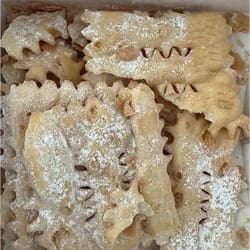
Even the names of the confections reflect this sense of free expression. The chiacchiere are called frappe in Rome, cenci in Tuscany, and bugie (“lies”) in Piedmont. In some places they’re even known as lattughe, or “lettuce”—a name that is inspired by their thin, wavy, leaflike shape and certainly brings a smile. Because Italy was a collection of city-states for so much of its history, the same sweets have a different name in each area. But whether you call them “chitchats,” “lies,” or “lettuce,” they all have a playful ring that’s perfectly suited to a festival of masks.
Chiacchiere are simple to make, just a batter of flour and egg stretched thin, fried, and dusted with powdered sugar. They aren’t too sweet, and immediately crumble in your mouth. The way the powdered sugar scatters is reminiscent of the way children playing at Carnevale toss confetti around, or the delicate snow that heralds the coming of spring.
Every town has its own Carnevale schedule, tradition, and name, but one thing is shared by all—people donning masks at the close of winter to make time to laugh, chat, and turn everyday life on its head for a little while.
So grab some chiacchiere and let your imagination run free through the whimsical events and stories that once unfolded in a world hidden by masks.
Photo is my own