






Luckily, an annual agreement between the Municipality and the FAI (Italian Environmental Fund), gives life to planned appointments to visit some villas and buildings which are normally closed to the public. Such buildings are mostly private or for government use only and therefore are not open for visits.
However, the FAI association aims at protecting and enhancing our heritage, networking with such properties. The FAI association volunteers donate their time, passion and expertise to preserve our memory and build the future, scheduling guided visits to a limited number of people.
This was my opportunity to visit Villa Gavotti in Albisola, where you can admire the evocative decorations of the Gallerie delle Quattro Stagioni (the four seasons hallways) by strolling through them. They overlook the wonderful garden, framed by emblematic Genoese Baroque statues.
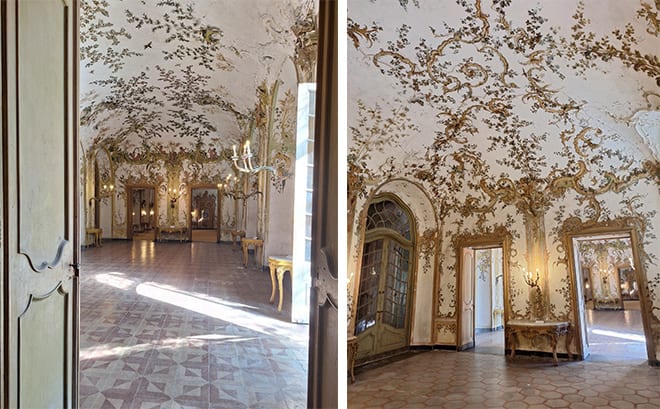
Tours were scheduled in the afternoon so the light was just perfect, filtering through the stained glass windows. Tradition holds that it is the birthplace of Giuliano della Rovere, who at the beginning of the 16th century became Pope Julius II, the pope patron of Michelangelo. Ancient documents state that this villa belonged to the della Rovere family since time immemorial and, only in the 18th century, it would be transformed into one of the most original Rococo buildings still standing in Italy.
The villa was a grandiose project aimed at transforming a vast portion of Albissola's territory into a unified landscape in which agriculture, art and architecture were re-imagined with innovation in the wake of the tastes of the Age of Enlightenment.
All around the villa, on marshy land subject to the flooding of the two streams that flow into the Albissola plain, canals were dug to collect and use the water for home use. These works were done to reclaim previously cultivated land, acquire new agricultural land and introduce new crops as well.
The houses and walls along the roads were made with yellow-orange plaster, adorned with architectural elements and frescoes too.
Located at a crossroad, the main entrance was embellished with vases and gates.
The knowledgeable FAI guides explained to us that such land reclamation and landscape transformation was commissioned by the Rovere and Gavotti families together and, from the second half of the 18th century, it continued even throughout the following century.
They said it was supposedly initiated by Francesco Maria della Rovere, the last heir of his family and he deserves credit for having wanted to build the current building with a patronage.
The villa was built on a structure dating back to the 15th century and traces of the old building still remain and are visible during the visit, along with the base of the tower and the floors.
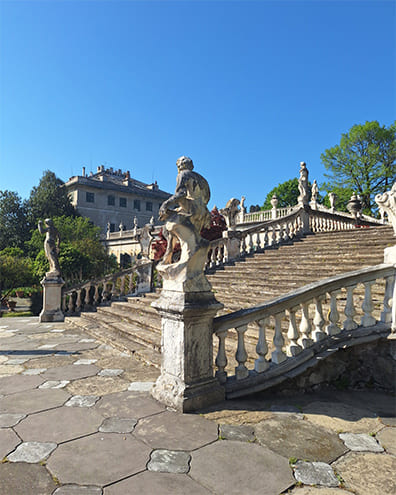
From the terraces, two staircases descend into the lower gardens.
The exterior is brightly painted in warm yellow-orange and decorated around the large windows with bright frescoes, flowers and tromps-l-oeil ornaments.
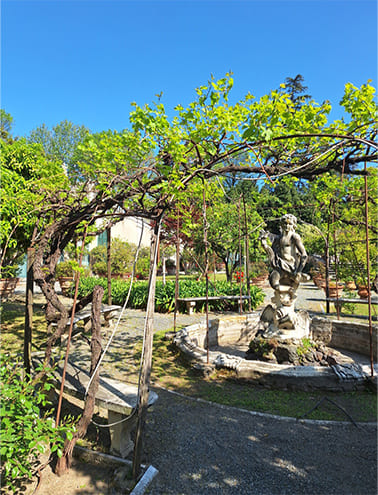
The garden is adorned with stone mermaids and dolphins in marble fountains and with large terracotta vases. The marble for the statues was sourced from Carrara in nearby Tuscany and it is the most prestigious marble we can find in Italy. The stones for the caves and the stalactites came from the natural caves of the hinterland taken at a time when it was legal to remove pieces from nearby caves without permission.
As mentioned above, there are four season inspired halls.
The Spring room has white walls and a window, while the others have vases, fashioned with imagination. The Summer room is adorned with cherubs harvesting wheat above a frame. On the vault, trees laden with fruit rise in high relief toward the curve of a sky, crossed by mythical birds. Finally, in the Autumn room, grape-laden vines spring from vases and baskets placed above the displays, extending across the vault and windows. Mirrors amplify the perspectives and the lights reflect from candelabras hanging above.
A true architectural masterpiece worth visiting.