






“These days, it’s pretty rare to see a startup building a robot from scratch, including its molds.”
“Most VCs tend to avoid hardware because the risks are simply too high.”
I still remember hearing these words from Japanese partner companies and people involved in our business.
Today, iPresence is redesigning and mass-producing its own product, Kubi 2.0, in Japan, with the goal of bringing it to markets around the world. A startup born in Kobe is taking its challenge beyond Japan, aiming to contribute to the country’s manufacturing industry while competing on the global stage.
That is the big challenge we have set for ourselves.
But behind the glamorous image of innovation lies a very different reality: countless struggles, setbacks, and rounds of trial and error.
As we worked on Kubi 2.0, I would occasionally hear comments like this:
“It’s just a two-axis robot — tilt and pan, right? You could probably have something like that made cheaply and easily in Shenzhen, China.”
To be honest, these days I sometimes find myself thinking:
“If you think it’s that easy, why not try doing it yourself?” (laughs)
There is a huge difference between cheaply producing a prototype and reliably manufacturing hundreds or thousands of identical units at consistent quality, taking responsibility for repairs and customer support, and ensuring a stable supply for years to come.
Being able to make something and actually taking responsibility for making it are two completely different things.
A product that combines software and hardware may look structurally simple on the outside, but underneath, it is an entirely different kind of challenge.
Even on the software side, the skills required for application development are completely different from those needed to control the electronics and circuit boards.
Then there is the hardware itself: designing the thickness of the plastic housing, selecting materials, tuning motors and electronic components, laying out circuit boards, and even getting the feel of a physical button exactly right. Every detail requires an extraordinary level of precision and fine-tuning.
Even a tiny discrepancy between the design and the actual manufacturing process, or a failure to properly communicate the design intent to the factory floor, can cause the robot to stop rotating smoothly or produce unexpected noises.
We repeatedly found ourselves in situations where additional costs and months of work could disappear because of seemingly minor issues.
Another question I hear quite often is:
“Won’t competitors just come along and copy it?”
Building a finished hardware product is not simply a matter of knowledge and technical skills.
What really drives a team through one obstacle after another is the conviction that “this product is truly needed by society,” combined with the deep trust and attachment that comes from wanting to deliver it to customers who have been waiting for it.
You can copy a product.
But you cannot easily copy the heart behind it.
Of course, it may be possible to imitate the outward appearance and specifications of a product.
But what cannot easily be copied is the firsthand knowledge we have accumulated over the past ten years — continuously listening directly to customers, hearing about their failures and frustrations, and improving the product based on how it is actually used in schools, hospitals, and businesses.
That accumulated knowledge from the field, together with the trust we have built with our customers, is our true competitive advantage.
It is difficult to capture in numbers or express as a list of specifications, but this decade of experience is what gives Kubi its real value.
A Little Background on Kubi
Let me take a moment to explain where Kubi came from.
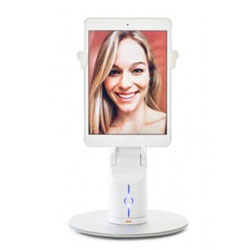
The original Kubi was a desktop telepresence robot developed by the Silicon Valley startup Revolve Robotics in the United States, which later became Xandex. We began importing and selling it in Japan in 2015 and have continued doing so for approximately ten years.
At iPresence, we also developed applications that integrated Kubi with Zoom, as well as systems designed for remote education, and delivered the product to customers across Japan.
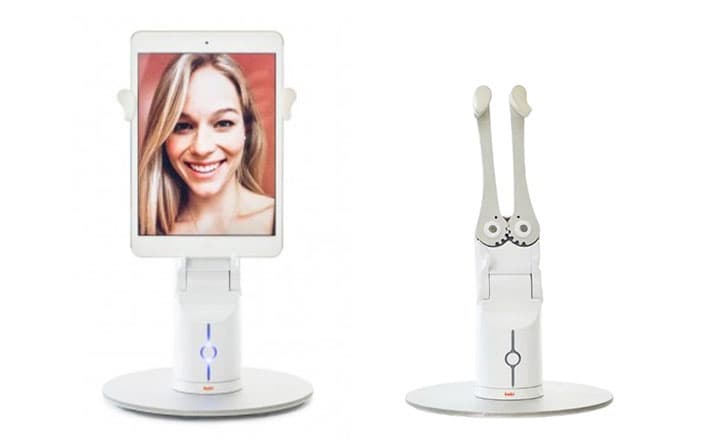
The original Kubi
However, after the COVID-19 pandemic, rising material and labor costs made it increasingly difficult to generate a profit from manufacturing in the United States. About two to three years ago, we were informed that production would be discontinued.
At the same time, our U.S. partner had developed a deep level of trust in iPresence as its first sales and development partner outside the United States. They approached us with an unexpected proposal:
Would we consider taking over the business and manufacturing rights?
Kubi was certainly a niche product, but more than 4,000 units had been sold globally, and there was a clear market need.
A product born in Silicon Valley could be redesigned in Kobe and carried into the next decade with the precision and reliability of Japanese manufacturing.
For someone like me, who wanted to pursue manufacturing as a Japanese company, it was an opportunity I could hardly have wished for more.
At first, I had a fairly straightforward plan.
If we could obtain the original drawings and the necessary information, I thought that our team — together with the members and partner companies who had previously designed, manufactured, and mass-produced our own compact telepresence robot, Telepii, or “the Moving Telephone” — should be able to reproduce essentially the same product.
So I immediately traveled to Silicon Valley to learn about the manufacturing process firsthand.
The people there had been involved with Kubi for many years, and they were genuinely sad to see the product disappear. I could also strongly sense how much they hoped we would take it forward.
But when I brought back videos and other documentation of the manufacturing process to Japan, the president of our partner factory gave me a rather shocking answer:
“Chris, we can’t mass-produce this as it is. We’d have to redesign it from the ground up.”
In the United States, Kubi had been assembled through highly skilled, almost artisanal manual processes.
From a manufacturer's perspective, however, this approach made it difficult to guarantee consistent quality or provide reliable maintenance and support in the future.
My immediate reaction was:
“Seriously…?”
Our original assumptions had been completely overturned.
But I trusted the factory president when he said that a redesign was possible.
So I told him:
“Okay. Then let’s rebuild it. We can keep the design and functionality as close to the current model as possible, but let’s make it something we can truly be proud of as a Made-in-Japan product.”
And that was the unexpected beginning of the Kubi 2.0 project.
Once we decided to redesign the product, we also took the opportunity to make a number of improvements.
We increased the battery capacity, switched to USB Type-C power, added an LED indicator showing the remaining battery level, and — especially important for schools — worked to make the motor and gears significantly quieter.
We incorporated ten years' worth of feedback and requests from customers and spent eight months working with our partner companies to create a full-scale production prototype.
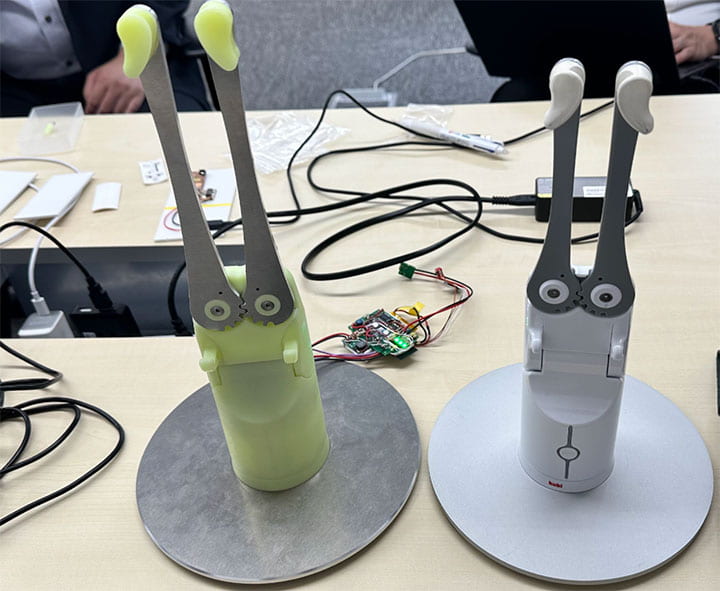
The prototype in development — on the left. In the early stages, we aimed to retain the same shape as the original model.
Finally, we reached the point where we could say:
“With this level of quality, we can do it!”
We were confident enough to obtain a quotation for mass production.
Then we added everything that would be required: domestic tooling and mold costs, international certification, minimum order quantities (MOQs) for components, acquisition of the brand rights, and more.
When we added it all up, the total came to an astonishing:
Approximately ¥100 million.
I had thought we had been careful about costs throughout the project.
But ¥100 million was an almost impossible figure for iPresence to invest on its own, and we had no clear path to securing funding elsewhere.
I was at a loss.
We had come this far. Was there any way we could find the money and continue?
Even to reach profitability, we would have to sell several thousand units.
But if we could sell them, the investment could eventually be recovered.
We couldn't give up here.
I kept thinking about the children who had been able to connect with their classrooms and the outside world through Kubi, the teachers who had placed their hopes in the technology, and the healthcare workers in hospitals who had used it to support patients.
Their faces kept coming back to me.
Our team held repeated discussions about whether there were alternative manufacturing methods, how we could reduce costs, and whether there was another way forward.
But eventually, we had to make a difficult decision:
We would give up on moving forward with the project in its current form.
It was May 2025.
I contacted our long-standing U.S. partner and told them that we had decided to abandon the project.
My hand was trembling as I typed the email, overwhelmed by frustration and disappointment.
And just like that, the dream of Kubi 2.0 came to a complete halt.
That was the hardest and most painful moment of the entire project.
To be continued in Part 2
In Part 2: Starting Over for the Second Time, Connecting with Physical AI, and Taking on the World