






In May 2025, faced with the ¥100 million hurdle of mass production, we informed everyone involved that we were abandoning the kubi 2.0 project. At the time, our company was extremely busy with projects such as “Expo Anywhere” at Expo 2025 Osaka, Kansai, Japan. Yet, deep down, I could not shake the feeling that we had left something unfinished.
Even after sales of the original kubi had ended, inquiries from the field continued to pour in.
“Is it no longer available for purchase?”
“We want to use it at our school.”
Amid this disappointment, our Japanese manufacturing partner came to us with a new structural design proposal. It took a completely different approach to the mechanism, with the potential to dramatically reduce the number of components.
“Could this actually work...?”
Having already announced that we were giving up, I could not casually say, “Let's do it.” Nevertheless, we cautiously began exploring the possibility of restarting the project. This led us back to a fundamental question:
“Do we really need to reproduce the original design exactly as it was?”
What we needed was not a perfect recreation of the past. Instead, we needed to preserve the strengths we had discovered through ten years of real-world use and redefine the product using Japanese engineering expertise and manufacturing methods.
We also changed our production strategy. Rather than aiming for an initial run of several thousand units, we redesigned the plan to start with a more manageable and realistic target of a few hundred units.
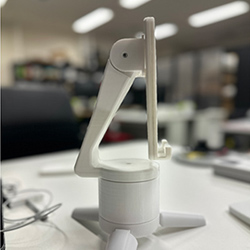
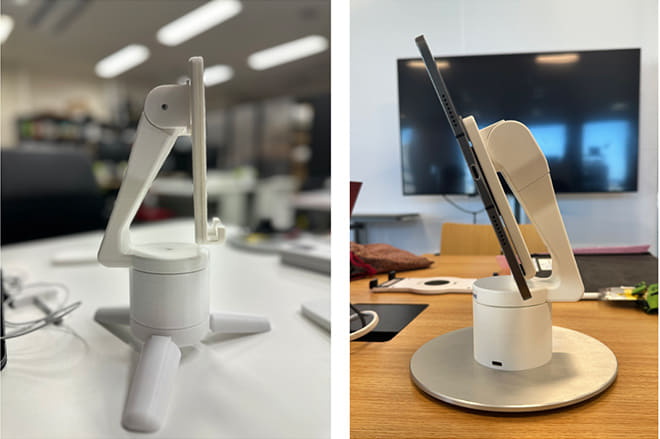 Caption: An early prototype following the project's restart. The proposed redesign eliminated the upper arm of the original kubi and introduced a magnetic mounting system to reduce the number of parts and cut costs. The tilt mechanism was also redesigned to operate from above, keeping the center of gravity low and improving overall stability.
In September 2025, we had the opportunity to exhibit at the Osaka Healthcare Pavilion at Expo 2025 Osaka, Kansai, Japan. There, we unveiled a prototype built around the new mechanical design.
Taking feedback from actual users into account, we continued refining the product and incorporating a decade's worth of real-world insights. We replaced the costly tablet holder with a magnetic mounting system, adopted a low-center-of-gravity design to prevent the device from tipping over, and added a quiet motor, USB Type-C power supply, battery-level indicator, and other improvements.
“With this design and cost structure, we might finally be able to make it work!”
Only after reaching this point of confidence did we contact the original US-based manufacturer again. However, since we had previously informed them that we were abandoning the project, their response was understandably tough.
“You gave up once already. Why are you trying to pursue this again?”
We had spent a long time working together to explore possibilities, so I could understand their disappointment. I wondered whether it would be possible to rebuild the trust we had lost.
That was precisely why we proceeded extremely carefully with discussions about restarting the project. Through persistent communication over time, we eventually secured their agreement to move forward together once again.
With that, the project began to gather momentum. But the real challenge was only just beginning.
The barrier between a prototype and a mass-produced product proved far higher and more formidable than we had imagined.
We faced countless challenges: selecting components, obtaining the complex certifications required for overseas sales, developing a marketing strategy, and, above all, understanding the consequences of every design change.
At the mass-production stage, even a deviation of just 0.1 millimeters can affect product quality. When it comes to molds, even a seemingly minor adjustment of just 1 millimeter can incur hundreds of thousands or even millions of yen in mold modification and verification costs.
We pushed the design to its limits, constantly battling the fear that even a small mistake could lead to enormous additional expenses.
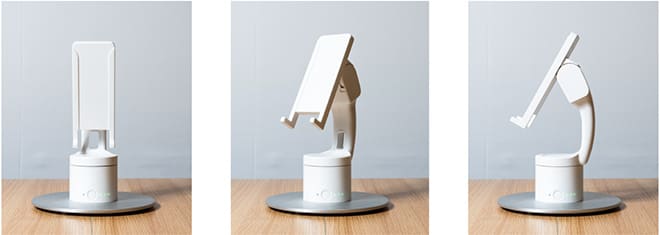 Caption: The final design of kubi 2.0.
As we developed kubi 2.0, we had also been looking ahead to integrating it with AI agents from the very beginning.
The concept was to enable the device to recognize people through a camera and turn toward them, allowing an AI agent to provide guidance in showrooms and at reception areas, then hand over to a remote human operator whenever necessary.
Then, in 2026, a term rapidly gained worldwide attention: Physical AI.
The concept refers to AI that moves beyond the virtual world, gaining a physical presence and interacting with real-world objects, people, and spaces.
When we exhibited at CES at the beginning of the year, Physical AI was also a major theme of the event, and we felt a strong sense that we were onto something.
It felt as though the world had finally caught up with what we had been pursuing so single-mindedly for ten years: the ability to convey presence.
kubi 2.0 has neither arms nor legs. Yet, when it comes to communicating with people, the significance of even the most basic forms of physical presence is enormous: turning toward someone, following the person who is speaking, and making eye contact with someone who approaches.
• For people, a body that allows them to be there remotely.
• For AI, a body that allows it to face people in the real world.
It was the moment when ten years of work in telepresence and the emerging world of Physical AI came together in a single product: kubi 2.0.
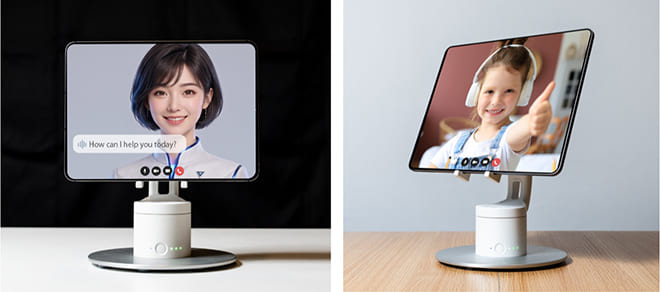 Caption: The AI-agent version of kubi 2.0 (left) and a conventional telepresence setup (right).
We had previously developed telepii, a compact remote communication robot, from scratch. We launched a crowdfunding campaign on Makuake, created production molds, and saw the entire process through to mass production and shipment.
Back then, we knew very little about what we were getting into. We made countless mistakes and learned some painful lessons along the way.
Yet, the experiences that had once felt like nothing but costly failures became powerful assets when we reached the most critical stages of kubi 2.0.
Whenever a problem arose, we could approach it calmly, thinking:
“Ah, this is similar to what happened back then. I know how we can get through this.”
Had we fully understood from the outset just how daunting hardware mass production could be, we might have been too afraid to take on this challenge in the first place.
I believe that one of the great privileges of being a startup is being able to take that first step precisely because you do not know everything, and then learn each time you encounter a new obstacle.
kubi was originally born in Silicon Valley in the United States. iPresence nurtured the product in Japan, and now, we are redesigning it in Kobe, drawing on the expertise of Japanese manufacturers to bring it back to the world with Made-in-Japan quality.
Our initial production run will consist of 300 units. For a global manufacturer, this might seem like a modest number. However, there is enormous significance in creating the molds ourselves, refining the quality with our own hands, and taking full responsibility for delivering the finished product to the world.
As the first step toward that goal, we launched our challenge to the global market in September 2026 through Kickstarter, an international crowdfunding platform.
We will never know how far we can go in the global market unless we try. But if we do not take on the world, the possibility of succeeding will remain at zero forever.
kubi 2.0 was a project we once came close to abandoning.
We are finally at the starting line, supported by the people who wrestled with difficult problems alongside us, went through countless design revisions, and never gave up; by everyone who encouraged us; and by the engineering expertise of Japan's manufacturing industry.
We invite you to follow our journey as a startup takes on what many might call a reckless challenge: bringing a Made-in-Japan product to the world.